While the 1976 Toxic Substances Control Act (TSCA) banned new production and most uses of polychlorinated biphenyls (PCBs), it allowed some historical uses to continue and set allowable limits for PCBs that occur as manufacturing by-products in other… …
Apple placed restrictions on benzene, beryllium, n-hexane, trichloroethylene (TCE), and other chlorinated solvents in manufacturing operations as part of its new Regulated Substances Specification. Apple also says “All suppliers subject… …
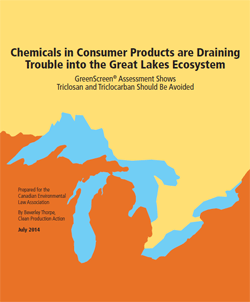
A new report from the Canadian Environmental Law Association (CELA) and Clean Production Action (CPA) uses GreenScreen® to evaluate two antibacterial chemicals and concludes that triclosan is a high hazard chemical whose use should be avoided. An… …
Antibacterial chemicals are polluting our waterways Most people are unaware of how widespread triclosan and triclocarban chemicals are in their daily lives. Many products labelled as ‘antibacterial’, ‘fights odours’ or… …
Businesses praise bill to avoid chemicals of high concern to human health and the environment Business leaders today urged the U.S. Senate to pass the Protecting America’s Families from Toxic Chemicals Act of 2014. The bill just introduced by… …
Senator Edward J. Markey (D-MA) and Representatives Lois Capps (D-CA) and Grace Meng (D-NY) have introduced the Ban Poisonous Additives (BPA) Act to bar the use of bisphenol A (BPA) in food and beverage containers nationwide in both reusable… …
Your soap may be toxic when flushed down the drain: New GreenScreen® for Safer Chemicals Tool Identifies Hazardous Chemicals in Common Household Products (Toronto, Canada) The Canadian Environmental Law Association (CELA) and… …
Most people are unaware of how widespread triclosan and triclocarban chemicals are in their daily lives. Triclosan is found in liquid hand soaps, cosmetics, toothpastes, moisturizers, and a wide range of other products. Triclocarban is also… …
A new report from the Food Packaging Forum identifies 175 potentially hazardous substances used legally in food contact materials. According to the report, many of these substances – chemicals used in food packaging or to produce those… …
The Plastics Scorecard v.1.0 offers the first comprehensive method for assessing and reducing chemicals of high concern in plastics. “From baby bottles made with BPA to medical devices made with DEHP, plastics are a surprising source of… …
Would you like to: Understand the deep connections between fossil fuels, chemicals, and plastics? Know how to measure Progress to Safer Chemicals in Polymer Manufacturing? Know how to measure the Chemical Footprint of a Plastic Product? The… …
Hair and nail care products are contributing to smog: The California Air Resources Board has fined 19 companies for selling consumer products that violate air quality standards for smog-producing volatile organic compounds (VOCs). The products… …
Plastics in turn, are a leading end use for flame retardants. They’re found in penguins and in mothers, breast milk and children across the United States; in household dust, ordinary supermarket food and in virtually every geographic location… …
The Plastics Scorecard demonstrates how companies need to pay attention to the chemicals in plastics and the end of life impacts of plastics. For companies looking to reduce their environmental footprint, including their use of hazardous… …
Plastics Scorecard ranks popular plastics Businesses praise new tool to assess “chemical footprint” of plastic Free Webinar on Plastics Scorecard will take place Tuesday, July 1, 11 a.m. ET. (Somerville, Massachusetts) By switching… …
By switching the type of plastic used in its IV bags, Dignity Health care system kept 700,000 pounds of high-concern chemicals — the equivalent in weight of a Boeing 747 airplane — out of the environment, according to BizNGO's new… …
Why companies need to do hazard assessments of alternatives … Testing for flame retardants in general consumer and children’s products by the state’s Department of Ecology found many “regrettable substitutions.” … …
Since 1976, when Congress enacted the Toxic Substances Control Act (TSCA) the EPA released its second final risk assessment for trichloroethylene (the first risk assessment covered asbestos). It focuses on the health risks from TCE exposure through… …