

Newsletter: May 27, 2021

New GreenScreen Registry accesses hundreds of chemical hazard assessments

Today the GreenScreen Assessment Registry joins the GreenScreen® family of tools that provide solutions on the journey to safer chemicals, materials, and products.  GreenScreen List Translator™ provides a quick pathway… …

Newsletter: May 6, 2021

GreenScreen Certified® -- identifying PFAS-free and preferred products for the health of people and the planet

  The per- and polyfluoroalkyl substances (PFAS) chemical class is under intense global scrutiny. From the European Union’s intention to phase out PFAS to individual state PFAS restrictions in the U.S. and the growing commitment by… …

Safer cosmetics for women of color start with transparency about chemical footprints

Investors are increasingly scrutinizing companies for environmental, social and ethical considerations. In addition to closer scrutiny of companies’ carbon and water footprints, a third mark of consideration is emerging: their chemical… …

Newsletter: April 1, 2021

Sign up for chemical footprint survey & see retailer progress in chemical footprinting

The Chemical Footprint Project 2021 Survey will be launched on April 15th, and we thought it a good idea to remind companies how the four interlinked pillars in the CFP Survey can help companies reduce their chemical footprint. And why this… …
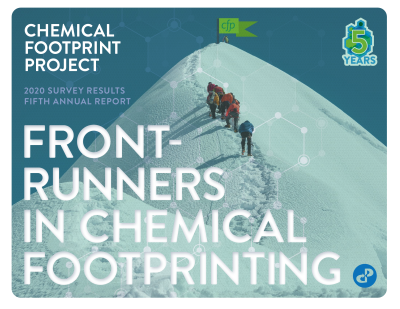

CFP 2020 Report: Front-runners in Chemical Footprinting

5th Annual Chemical Footprint Project Report features best practices in proactive chemicals management by Beautycounter, Herman Miller, HP Inc., Humanscale, Naturepedic, RB (Reckitt Benckiser), & Seventh Generation Somerville, MA –… …

Newsletter: December 30, 2020

2020 in the rearview mirror

In the midst of a global pandemic, the team at Clean Production Action continued to bend the course of the toxic chemicals economy to safer solutions.  We transitioned to a completely virtual organization, ceased all travel, yet continued to… …

Can big data, AI and chemical footprinting help the renewable energy sector avoid a toxic waste legacy? by Mark Rossi, Alexandra McPherson, Chitra Rajan, Krishna Rajan

"Three years ago, the Department of Materials Design and Innovation at the University at Buffalo, Clean Production Action (CPA) and Niagara Share created the Collaboratory for a Regenerative Economy (CoRE). CoRE recognizes the critical societal… …

Newsletter: November 25, 2020

GreenScreen trainings open for registration

Learn all the elements of hazard assessment as defined by GreenScreen. Start with Advanced Topics and progress to being a Practitioner. If you are new to GreenScreen, check out the Introductory Course.   Register for Advanced… …

Newsletter: November 18, 2020

Meeting the demand for renewable energy with safer materials

     Meeting the challenge of global climate change requires significant new investments in renewable energy. Yet the renewable energy economy depends on toxic chemicals. Lead in solar panels. Cadmium telluride in solar cells.… …

Safely meeting demand for renewable energy with innovative material design for health and sustainability by Mark Rossi and Alexandra McPherson

Clean energy is critical to solving our climate crisis. But we need to consider the full environmental and human health impacts of solar energy generation across its entire lifecycle, including mining, manufacturing, use, decommissioning and recycling.

In 2017, the Department of Materials Design and Innovation at the University of Buffalo, Clean Production Action, and Niagara Share created the Collaboratory for a Regenerative Environment (CoRE). CoRE brings together academic experts in materials… …