It’s now the law in: Vermont: Act No. 188 (S 239) requires manufacturers of children’s products to notify the State if the product contains a chemical of high concern and empowers that State to prohibit the sale of or require labeling of… …
It’s now the law in: Maryland: HB 229 bans children’s products containing the flame retardants TDCPP (tris(1,3-dichloro-2-propyl)phosphate) and TCEP (tris(2-chloroethyl)phosphate). New York: AB 4741 / SB 3703 bans children’s… …
Coming soon: California: SB 270 would make the State the first to enact a statewide ban on plastic bags. The bill passed the Assembly & Senate (on the Governor’s desk for action by September 30th). Note: each county in Hawaii bans plastic… …
According to the latest Greenpeace report, brands are making progress in reducing polyvinyl chloride (PVC) plastic and brominated flame retardants (BFRs) in products. Apple is leading the pack in completely eliminating these chemicals in personal… …
Brominated and other flame retardants are losing the health care market. Four health care providers -- Advocate Health Care, Beaumont Health System, Hackensack University Medical Center, and University Hospitals -- announced they will stop buying… …
The two US retail giants joined together with their supply chain last week in Chicago at the “Beauty and Personal Care Products Sustainability Summit.” At the top of their agenda: “impacts of chemicals (health &… …
Some novel innovations aimed at reducing waste have been garnering attention this summer, including one pioneered by the company WikiFoods, Inc. The company describes its new material, WikiPearl, as “a protective electrostatic gel formed by… …
While the 1976 Toxic Substances Control Act (TSCA) banned new production and most uses of polychlorinated biphenyls (PCBs), it allowed some historical uses to continue and set allowable limits for PCBs that occur as manufacturing by-products in other… …
Apple placed restrictions on benzene, beryllium, n-hexane, trichloroethylene (TCE), and other chlorinated solvents in manufacturing operations as part of its new Regulated Substances Specification. Apple also says “All suppliers subject… …
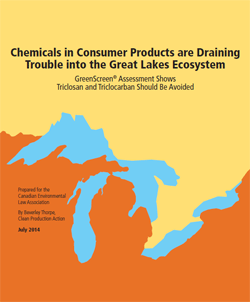
A new report from the Canadian Environmental Law Association (CELA) and Clean Production Action (CPA) uses GreenScreen® to evaluate two antibacterial chemicals and concludes that triclosan is a high hazard chemical whose use should be avoided. An… …
Antibacterial chemicals are polluting our waterways Most people are unaware of how widespread triclosan and triclocarban chemicals are in their daily lives. Many products labelled as ‘antibacterial’, ‘fights odours’ or… …
Businesses praise bill to avoid chemicals of high concern to human health and the environment Business leaders today urged the U.S. Senate to pass the Protecting America’s Families from Toxic Chemicals Act of 2014. The bill just introduced by… …
Senator Edward J. Markey (D-MA) and Representatives Lois Capps (D-CA) and Grace Meng (D-NY) have introduced the Ban Poisonous Additives (BPA) Act to bar the use of bisphenol A (BPA) in food and beverage containers nationwide in both reusable… …
Your soap may be toxic when flushed down the drain: New GreenScreen® for Safer Chemicals Tool Identifies Hazardous Chemicals in Common Household Products (Toronto, Canada) The Canadian Environmental Law Association (CELA) and… …
Most people are unaware of how widespread triclosan and triclocarban chemicals are in their daily lives. Triclosan is found in liquid hand soaps, cosmetics, toothpastes, moisturizers, and a wide range of other products. Triclocarban is also… …
A new report from the Food Packaging Forum identifies 175 potentially hazardous substances used legally in food contact materials. According to the report, many of these substances – chemicals used in food packaging or to produce those… …
The Plastics Scorecard v.1.0 offers the first comprehensive method for assessing and reducing chemicals of high concern in plastics. “From baby bottles made with BPA to medical devices made with DEHP, plastics are a surprising source of… …
Hair and nail care products are contributing to smog: The California Air Resources Board has fined 19 companies for selling consumer products that violate air quality standards for smog-producing volatile organic compounds (VOCs). The products… …